In aerospace electronics, PCB material choice impacts thermal performance, reliability, stability, and long-term durability. The most common options are FR4 and polyimide, and the right selection depends on the application and environment.
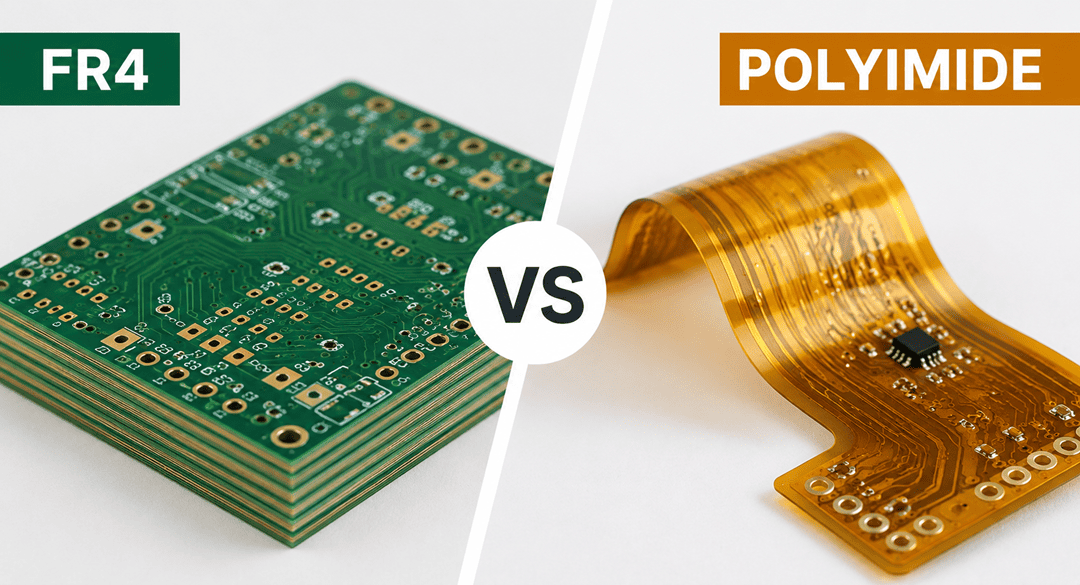
FR4 is widely used for rigid PCBs due to its good balance of performance, strength, and cost. Polyimide is preferred for flexible and rigid-flex PCBs where higher thermal stability and flexibility are required.
There is no single “better” material. The choice depends on temperature range, mechanical stress, flexibility needs, electrical requirements, and environmental conditions.
In this guide compares FR4 vs polyimide for aerospace PCBs and helps you choose the right material for your application.
High-Temperature Demands in Aerospace PCB Design
Unlike consumer electronics, aerospace systems must operate across extreme temperature ranges that can shift rapidly and repeatedly. PCBs in these systems may experience:
- High-altitude low-temperature exposure
- Heat generated from dense electronic assemblies
- Rapid thermal transitions during mission phases
- Long-term thermal cycling fatigue
A high-temperature PCB material must maintain three critical properties under stress:
- Electrical insulation stability
- Dimensional consistency under expansion
- Mechanical integrity across repeated thermal cycles
When these properties degrade, failures such as delamination, signal loss, or circuit cracking can occur, none of which are acceptable in aerospace environments.
FR4 in Aerospace Electronics
Flame Retardant Grade 4 (FR4) is a glass-fiber reinforced epoxy laminate commonly used in commercial electronics, industrial controls, and aerospace subsystems operating in controlled environments.
Despite being a standard PCB material, FR4 continues to play an important role in aerospace electronics. Here are the key benefits.
- Cost-Effective Manufacturing: FR4 offers a lower-cost alternative to high-performance materials such as polyimide, helping manufacturers control production costs while maintaining reliable performance in suitable applications.
- Mature Manufacturing Ecosystem: As the most widely used PCB material, FR4 is supported by an established global supply chain and extensive manufacturing expertise. This results in shorter lead times, easier sourcing, and consistent production quality.
- Reliable Performance in Moderate Conditions: FR4 provides stable electrical insulation and mechanical strength for aerospace subsystems that are not exposed to extreme temperatures or severe thermal cycling, ensuring dependable long-term operation.
- Prototyping and Development Suitability: Its affordability and ease of fabrication make FR4 an excellent choice for prototype development, design validation, and testing before moving to more specialized materials if required.
Limitations of FR4 in High-Temperature Environments
While FR4 performs reliably in many aerospace applications within controlled conditions, its capabilities become increasingly limited as operating temperatures rise. Some of the key limitations of FR4 include:
- Reduced mechanical strength at elevated temperatures
- Higher coefficient of thermal expansion (CTE), leading to increased material stress
- Moisture absorption that can affect long-term performance
- Lower resistance to thermal fatigue during repeated heating and cooling cycles
- Increased risk of warpage and delamination under prolonged thermal exposure
Although these limitations may not affect all aerospace systems, they become critical considerations in high-temperature, high-reliability, and mission-critical applications where long-term performance is essential.
Polyimide in Aerospace Electronics
Polyimide is a high-performance polymer specifically engineered for environments requiring exceptional thermal and mechanical stability. Here are the key advantages of polyimide for aerospace PCBs:
- Superior Thermal Resistance: Polyimide offers significantly higher thermal endurance, allowing it to maintain performance and structural integrity even under prolonged exposure to elevated temperatures.
- High Glass Transition Temperature (Tg): Its high glass transition temperature (Tg) enables stable operation under continuous thermal stress, reducing the risk of material softening and performance degradation.
- Excellent Thermal Cycling Performance: Polyimide can withstand repeated heating and cooling cycles with minimal degradation, making it ideal for aerospace applications where temperature fluctuations are frequent and severe.
- Low Thermal Expansion: With a lower coefficient of thermal expansion (CTE), polyimide experiences less dimensional change during temperature variations, helping maintain solder joint reliability and component alignment.
- Enhanced Mechanical Stability: Polyimide retains its structural strength under both thermal and mechanical stress, providing dependable performance in environments characterized by vibration, shock, and dynamic loading.
- Long Operational Life: Its resistance to thermal fatigue and environmental stress contributes to extended service life, making polyimide a preferred choice for aerospace systems.
Challenges of Using Polyimide
While polyimide offers excellent thermal and mechanical performance, it also comes with certain trade-offs. Here are some key challenges to consider when selecting Polyimide for aerospace PCB applications:
- Higher Material Cost: Polyimide laminates are more expensive than FR4, increasing overall PCB costs.
- More Complex Manufacturing: Fabrication requires tighter process control and experienced PCB manufacturers to ensure consistent quality.
- Longer Lead Times: Specialized materials and manufacturing processes can result in longer production schedules.
- Not Always Necessary: For applications operating under moderate conditions, the added performance of polyimide may not justify the higher cost.
FR4 vs Polyimide Comparison for Aerospace Electronics
A detailed Polyimide vs FR4 evaluation requires more than comparing costs; it requires understanding how each material performs under the thermal, mechanical, and environmental demands of aerospace electronics.
The table below provides a side-by-side comparison of their key characteristics to support informed material selection.
| Parameter | FR4 | Polyimide |
| Continuous Operating Temperature | Typically up to 130–140°C | Typically up to 250–300°C |
| Glass Transition Temperature (Tg) | ~130–170°C | ~250–360°C |
| Coefficient of Thermal Expansion (CTE) | Higher | Lower |
| Moisture Absorption | Higher | Lower |
| Layer Stability | Good for standard multilayer PCBs | Excellent for high-layer-count and high-density PCBs |
| Electrical Stability Under Thermal Stress | Good | Excellent |
| Flame Resistance | UL94 V-0 | UL94 V-0 |
| Mechanical Performance | Good rigidity and strength | Superior strength under extreme conditions |
| Thermal Stress Handling | Moderate | Excellent |
| Aerospace Suitability | Controlled-environment aerospace electronics | Mission-critical aerospace and defense electronics |
| Relative Cost | Lower | Higher |
| Manufacturing Complexity | Standard fabrication processes | Specialized fabrication processes |
| Availability | Widely available | More specialized |
| Long-Term Reliability in Harsh Environments | Good | Excellent |
When Should Engineers Choose FR4?
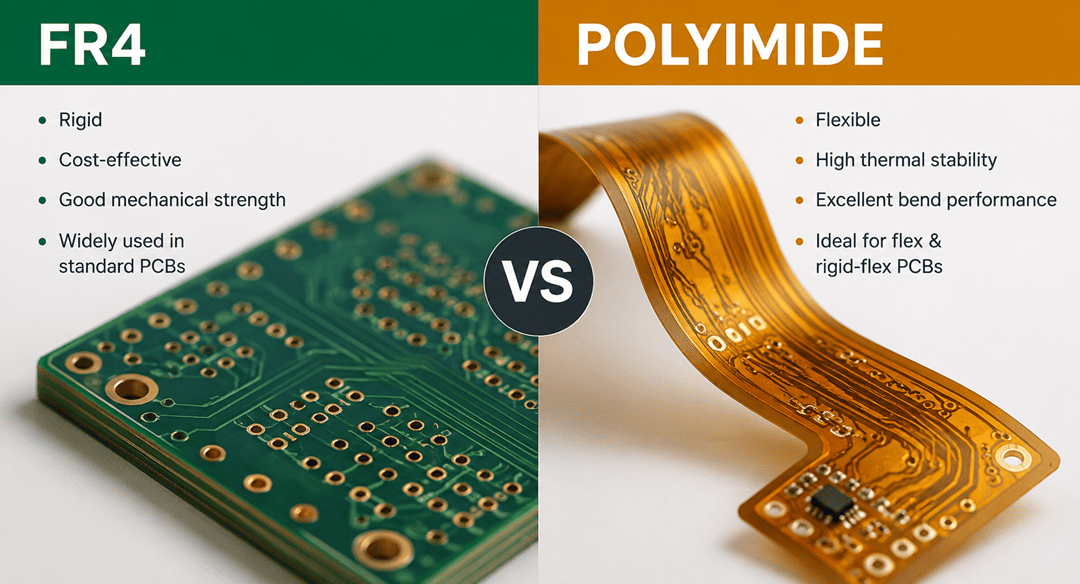
FR4 is the preferred choice when the application requires a balance between performance, manufacturability, and project cost. It is particularly well-suited for aerospace electronics that operate within predictable conditions and do not require the enhanced environmental resilience offered by advanced laminate materials.
Engineers often select FR4 for:
- Early-stage product development and qualification programs
- Cost-sensitive aerospace projects
- Support systems with predictable operating profiles
- Electronics that are not continuously exposed to extreme environmental stress
- Programs where rapid production and material availability are key considerations
Typical applications include:
- Cabin electronics
- Ground-support equipment
- Non-critical avionics modules
- Development and validation prototypes
When Should Engineers Choose Polyimide?
Polyimide becomes the material of choice when system performance and reliability take precedence over manufacturing cost and complexity. It is commonly selected for aerospace programs where the operating environment places exceptional demands on electronic assemblies throughout their service life.
Engineers typically choose polyimide for:
- Safety-critical and mission-critical electronics
- Systems exposed to demanding environmental conditions
- Long-duration aerospace and defense programs
- Applications requiring maximum operational reliability
- Platforms where maintenance access is limited or impractical
Common applications include:
- Flight control systems
- Satellite electronics
- Defense electronics
- Space-grade hardware
- High-density aerospace computing systems
Read More: Why Polyimide PCBs Are Beneficial
How to Select the Right PCB Material for an Aerospace Application
Rather than starting with the question “FR4 or polyimide?”, engineers should begin with the application’s requirements.
1. Define the Operating Temperature
Determine the expected minimum and maximum temperatures and the duration of exposure.
2. Evaluate Thermal Cycling
Identify how frequently the PCB will move between temperature extremes and how rapidly those changes occur.
3. Determine Whether Flexibility Is Required
If the circuit must bend, fold, or conform to a three-dimensional package, a flexible or rigid-flex construction may be more appropriate.
4. Evaluate Mechanical Requirements
Consider vibration, shock, bending, mounting conditions, connector interfaces, and component loading.
5. Evaluate Electrical Requirements
Review dielectric properties, impedance requirements, frequency, signal integrity, voltage requirements, and insulation characteristics.
6. Consider Moisture and Environmental Exposure
Aerospace electronics may be exposed to different environmental conditions throughout their lifecycle. Material selection should account for the actual environment.
7. Review Manufacturing Requirements
The selected material must be compatible with the required PCB fabrication process, layer configuration, drilling, lamination, plating, and assembly requirements.
8. Review Qualification Requirements
For aerospace and defense applications, material selection may need to align with customer specifications, industry standards, qualification procedures, and program-specific requirements.
9. Evaluate Total Cost
Compare not only laminate cost but also the overall manufacturing, assembly, packaging, installation, and lifecycle costs.
Achieve Aerospace-Grade Reliability with Rigiflex Technology
Choosing between polyimide and FR4 is not about selecting the most advanced material; it’s about selecting the right material for the application. The ideal PCB substrate is one that meets the required performance, reliability, and cost objectives throughout the product lifecycle.
At Rigiflex Technology, we manufacture high-reliability rigid, flex, and rigid-flex PCBs for aerospace, defense, and other demanding applications. Contact our team to identify the right PCB material and build a solution tailored to your performance requirements.
Frequently Asked Questions (FAQs)
Is FR4 or polyimide better for aerospace PCBs?
Neither material is universally better. The correct choice depends on the application’s thermal, mechanical, electrical, flexibility, environmental, cost, and qualification requirements.
Can FR4 and polyimide be used in the same PCB design?
Yes. In certain specialized applications, hybrid constructions may be used to balance performance and cost. However, compatibility, manufacturing requirements, and reliability considerations must be carefully evaluated during the design phase.
Does the choice of PCB substrate affect assembly processes?
Yes. Different substrate materials can influence lamination, drilling, soldering, and assembly parameters. Engineers should consider the entire manufacturing process when selecting a PCB material.
Are polyimide PCBs more difficult to inspect and test?
Not necessarily. However, their specialized construction and intended use in high-reliability applications often require stricter quality control, testing procedures, and certification requirements.
Are polyimide and FR4 suitable for rigid-flex PCB designs?
Both materials can be used in rigid-flex constructions, although polyimide is more commonly used in flexible circuit sections due to its excellent flexibility and durability.
How early should PCB material selection be made in the design process?
Material selection should be considered during the initial design stages, as it can influence stack-up design, manufacturing methods, qualification requirements, and overall project costs.