In flex circuit engineering, materials are not simply construction elements, they are performance drivers. The right combination of flex PCB materials can improve bend life, support signal integrity, withstand harsh environments, and extend product reliability, while the wrong choices can introduce fatigue, delamination, or premature failure. For engineers and OEMs, understanding flex PCB material types is fundamental to successful design.
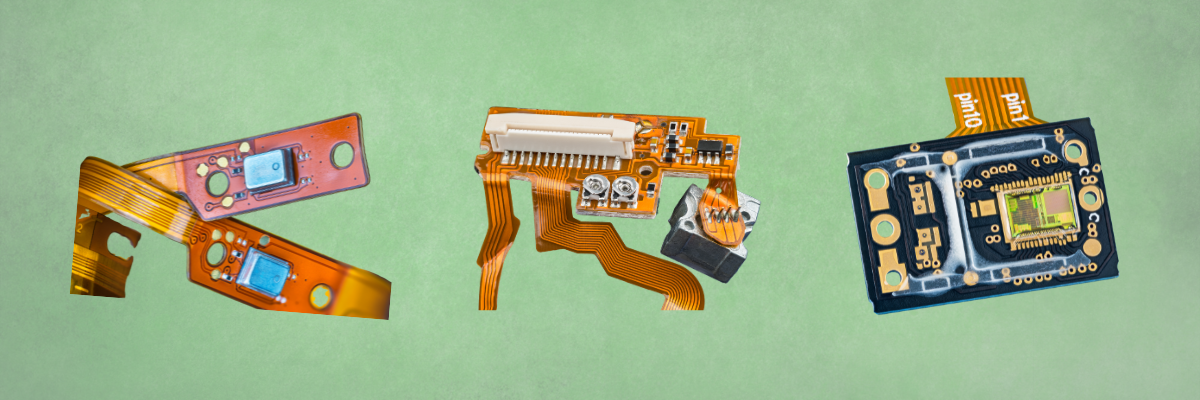
In this guide, we will explore everything you need to know about flex PCB materials, their types, and how to choose the right ones for your specific application.
Core Materials Used in Flex PCBs
Flexible circuit performance depends heavily on material selection. Each layer in the stackup influences flexibility, electrical performance, and long-term reliability. Understanding these core flex PCB materials is essential for effective design and application performance.
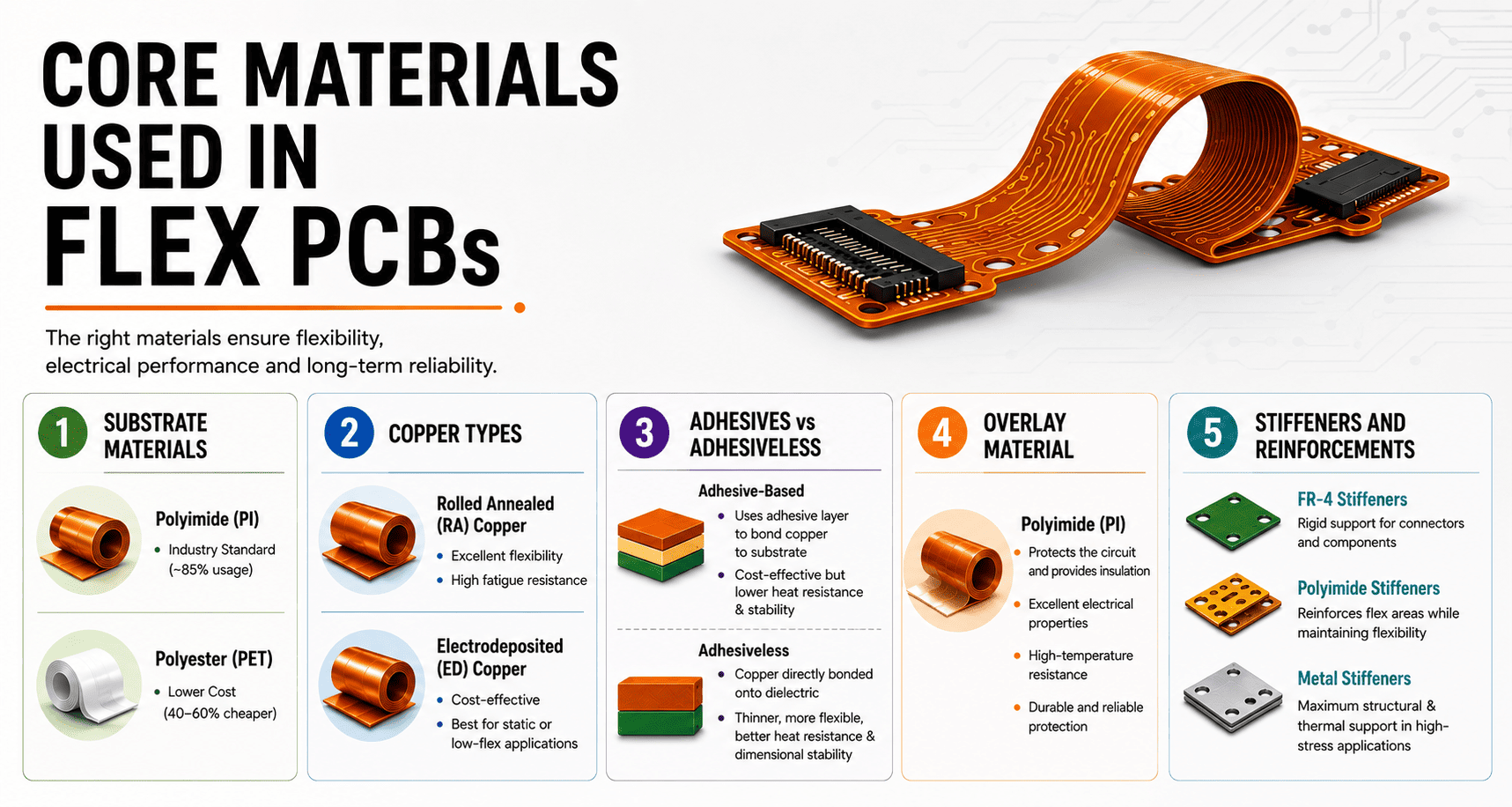
Key components include:
- Substrate Materials (Foundation Layer): The substrate is the most critical component of a flex PCB, providing the structure and flexibility necessary for various applications. The two most common substrate materials used in flex PCBs are Polyimide (PI) and Polyester (PET).
- Polyimide (PI)- Industry Standard (~85% usage): Polyimide is the most widely used substrate material for flex PCBs due to its excellent properties. It can withstand extreme temperatures, making it ideal for high-performance applications in aerospace, automotive, and medical sectors.
- Polyester (PET)-Lower Cost (40–60% cheaper): PET is a more affordable alternative to Polyimide, making it suitable for less demanding applications. Polyester has a limited temperature tolerance and is not ideal for high-temperature environments.
- Copper Types in Flex PCBs: The copper layer in flexible PCBs is critical to ensuring electrical conductivity and mechanical performance. The two primary types of copper used are Rolled Annealed (RA) copper and Electrodeposited (ED) copper. These differ mainly in flexibility, durability, and cost.
- Rolled Annealed (RA) Copper: RA copper is manufactured by rolling and annealing the material, which aligns its grain structure and improves ductility. As a result, it offers excellent flexibility and fatigue resistance, making it ideal for applications involving repeated or dynamic bending.
- Electrodeposited (ED) Copper: ED copper is produced through an electrochemical deposition process. It is more cost-effective than RA copper but has a columnar grain structure that makes it less flexible and more prone to cracking under repeated bending. Therefore, ED copper is best suited for static or low-flex applications, where the circuit will not experience frequent movement.
- Adhesives vs Adhesiveless Materials: Flex PCBs can be manufactured using either adhesive-based or adhesiveless materials, each offering distinct advantages.
- Adhesive-Based: This construction uses an adhesive layer to bond copper foil to the flexible substrate.While cost-effective, adhesive-based flex PCBs have limitations in terms of heat resistance and dimensional stability.
Adhesiveless: In adhesiveless constructions, copper is directly bonded or cast onto the dielectric without a separate adhesive layer. This reduces material thickness, improves flexibility, enhances heat resistance, and provides superior dimensional stability.
- Coverlay Materials: The coverlay is an essential part of the flex PCB, serving both as a protective layer and insulation. The most common coverlay material is Polyimide (PI), known for its excellent electrical properties, high-temperature resistance, and durability.
- Stiffeners and Reinforcements: Stiffeners and reinforcements are used in flex PCBs to provide additional support, particularly in areas where connectors or components are mounted. Common materials used for stiffeners include:
- FR-4 Stiffeners: FR-4 stiffeners provide rigid mechanical support in connector and component mounting areas, improving dimensional stability, solder joint reliability, and resistance to handling or insertion stress.
- Polyimide Stiffeners: Polyimide stiffeners reinforce flexible regions while maintaining a low-profile construction, offering added mechanical strength without significantly reducing circuit flexibility.
- Metal Stiffeners: Metal stiffeners provide maximum structural reinforcement and thermal support in high-stress applications where added rigidity, durability, or heat dissipation is required.
Flex PCB Material Selection Based on Application
Flex PCB material selection depends heavily on the nature of the application.
The following guidelines outline the key considerations:
- Dynamic Flex Applications: In dynamic applications, the PCB is subjected to continuous or repeated bending, such as in wearable devices or foldable electronics. In these cases, flexibility and long-term durability are critical. Here are key material considerations for dynamic flex applications.
- Rolled Annealed (RA) Copper is recommended because it has high ductility and excellent fatigue resistance, allowing it to withstand repeated bending without cracking.
- Thinner substrates should be used to reduce stiffness, which improves flexibility and minimizes mechanical stress during bending.
- Adhesiveless constructions are preferred as they offer better thermal stability and dimensional consistency, improving reliability under constant flexing.
- Static Flex Applications: In static applications, the PCB may be bent during installation but remains fixed during normal operation. Here, cost efficiency becomes more important than extreme flexibility. Here are the key material considerations.
- Electrodeposited (ED) copper is sufficient since the circuit does not experience repeated flexing, making it a more economical choice than RA copper.
- Adhesive-based materials can be used to further reduce manufacturing costs without significantly affecting performance in non-dynamic conditions.
- High-Speed / RF Applications: High-speed and RF designs require precise signal transmission, where electrical performance takes priority over mechanical flexibility. Following materials are well suited for such demanding applications.
- Low dielectric constant materials should be selected to minimize signal loss and maintain signal speed.
- Materials that support controlled impedance designs are essential for maintaining signal integrity, minimizing reflections, and reducing electromagnetic interference.
How Material Choice Impacts Performance
The materials selected for flexible PCBs play a crucial role in determining their overall performance. From electrical to mechanical to thermal properties, each material has a significant impact on how the PCB performs under various conditions.
- Electrical Performance: The right materials are essential for optimizing electrical performance, particularly in high-speed or RF applications. Here’s how material choices affect this:
- Signal Loss: Materials with low dielectric constants help minimize signal loss, which is especially important in high-frequency or high-speed circuits. By reducing signal degradation, these materials ensure more reliable performance in time-sensitive applications.
- Impedance: The material stackup and the choice of copper type directly influence the impedance of the PCB. A consistent and controlled impedance is essential for maintaining signal integrity and ensuring that signals travel without distortion or reflection.
- Mechanical Performance: Mechanical behavior plays a critical role in flex PCB reliability, especially in applications involving bending, vibration, or repeated mechanical stress. Material selection directly impacts flexibility, bend life, and long-term structural integrity:
- Bend Cycles: Choosing flexible materials like RA copper and polyimide substrates enhances the PCB’s ability to withstand repeated bending without failure. These materials support a higher number of bend cycles, crucial for applications such as wearables or foldable electronics.
- Fatigue Resistance: Repeated flexing can cause material fatigue over time. Selecting materials with high fatigue resistance helps mitigate long-term wear, ensuring the PCB lasts longer even under constant motion or stress.
- Thermal Performance: Thermal behavior is a key factor in flex PCB reliability, especially in applications exposed to elevated operating temperatures where material stability directly impacts long-term performance. The key thermal material requirement is as follows:
- Thermal Stability: Materials such as polyimide offer excellent thermal stability, allowing the PCB to perform reliably in extreme heat conditions. This is especially important for applications exposed to high temperatures, where maintaining structural integrity and functionality is critical.
Common Flexible PCB Material Selection Mistakes
Here are some common mistakes to avoid:
- Using PET in High-Temp Environments: PET is not suitable for high-temperature applications, so it’s important to choose a material with better heat resistance, such as polyimide.
- Wrong Copper for Dynamic Flex: Using ED copper for dynamic flex applications can lead to early failure, RA copper is preferred for such use cases.
- Selecting materials incompatible with bend radius requirements: Using materials that cannot support the required bend radius leads to excessive stress concentration, copper cracking, and premature flex failure in dynamic or tight-radius applications.
- Overengineering stackup with unnecessary material layers: Adding excessive layers or complex material combinations without functional need increases cost, stiffness, and fabrication complexity, often without meaningful performance gain.
Selecting the right flex PCB materials directly influences circuit reliability, performance stability, and long-term durability across demanding applications. At Rigiflex Technology, we support engineers and OEMs with application-driven flex PCB material selection and precision manufacturing. Our expertise spans a wide range of flex circuit materials, enabling optimized designs for dynamic, static, and high-speed applications.